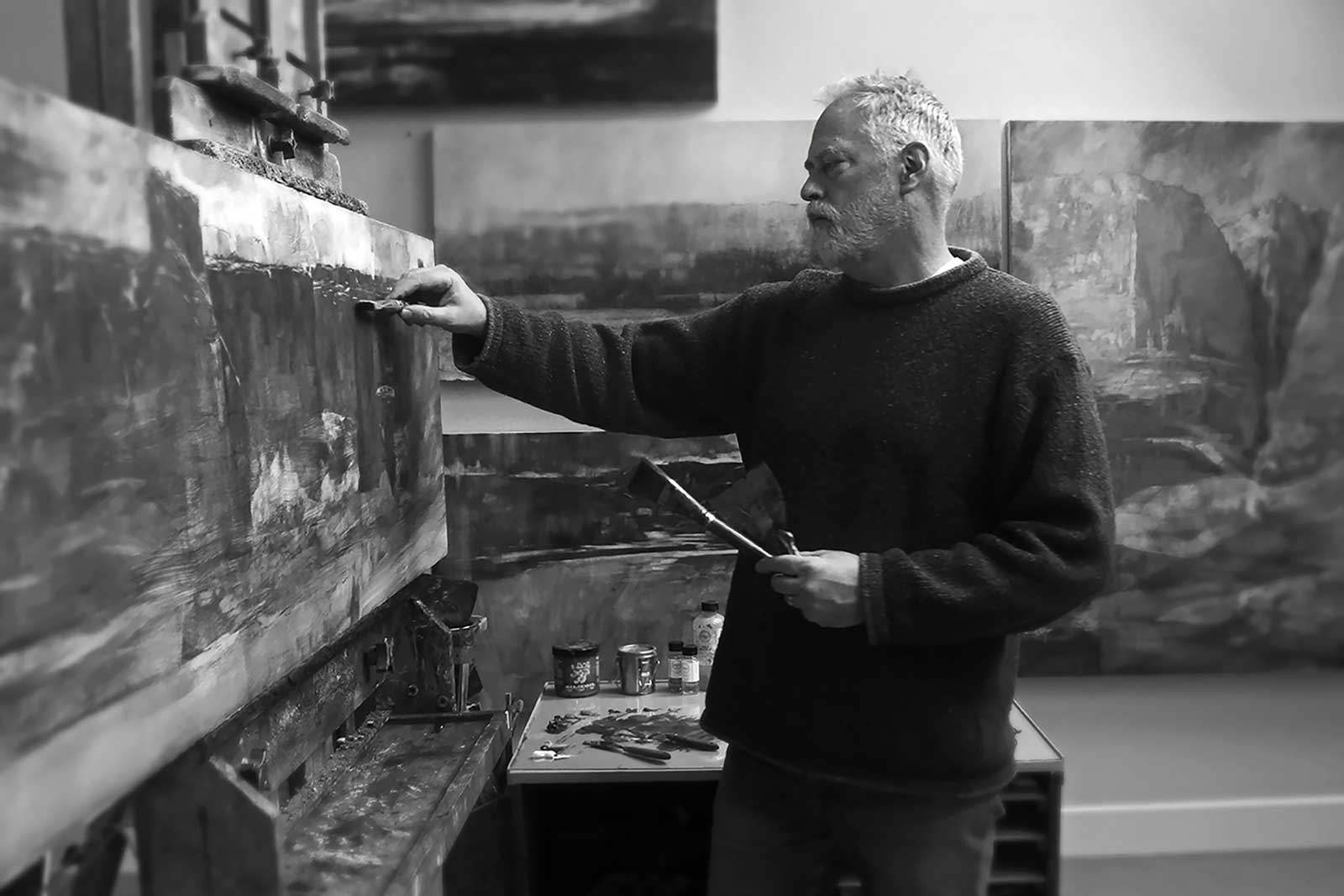
Douglas Fryer in studio
Scottsdale Artists’ School: You are the Signature Artist for Scottsdale Artists’ School’s Beaux Arts this year. Tell us about that. Douglas Fryer: It is a wonderful honor. I have been associated with the school for many years and have a great respect for SAS. It was a pleasure to donate my painting titled July, a 24-by-24-inch oil on panel. It is a landscape of several horses grazing in a warm, yellow field of grass. I wanted the painting to be more of a symbolic environment, using bright colors and abstract passages of paint. The overlapping shapes of the horses express a passage of time, suggesting that they have moved and are moving slowly through the grass.SAS: Tell us about teaching at SAS?
DG: I have been teaching at the Scottsdale Artists’ School for about six years now. There is an energy like no other. The students are motivated by the instruction, environment and collaboration with other like-minded artists. Many of them meet there and continue their professional association and friendship for years afterward.
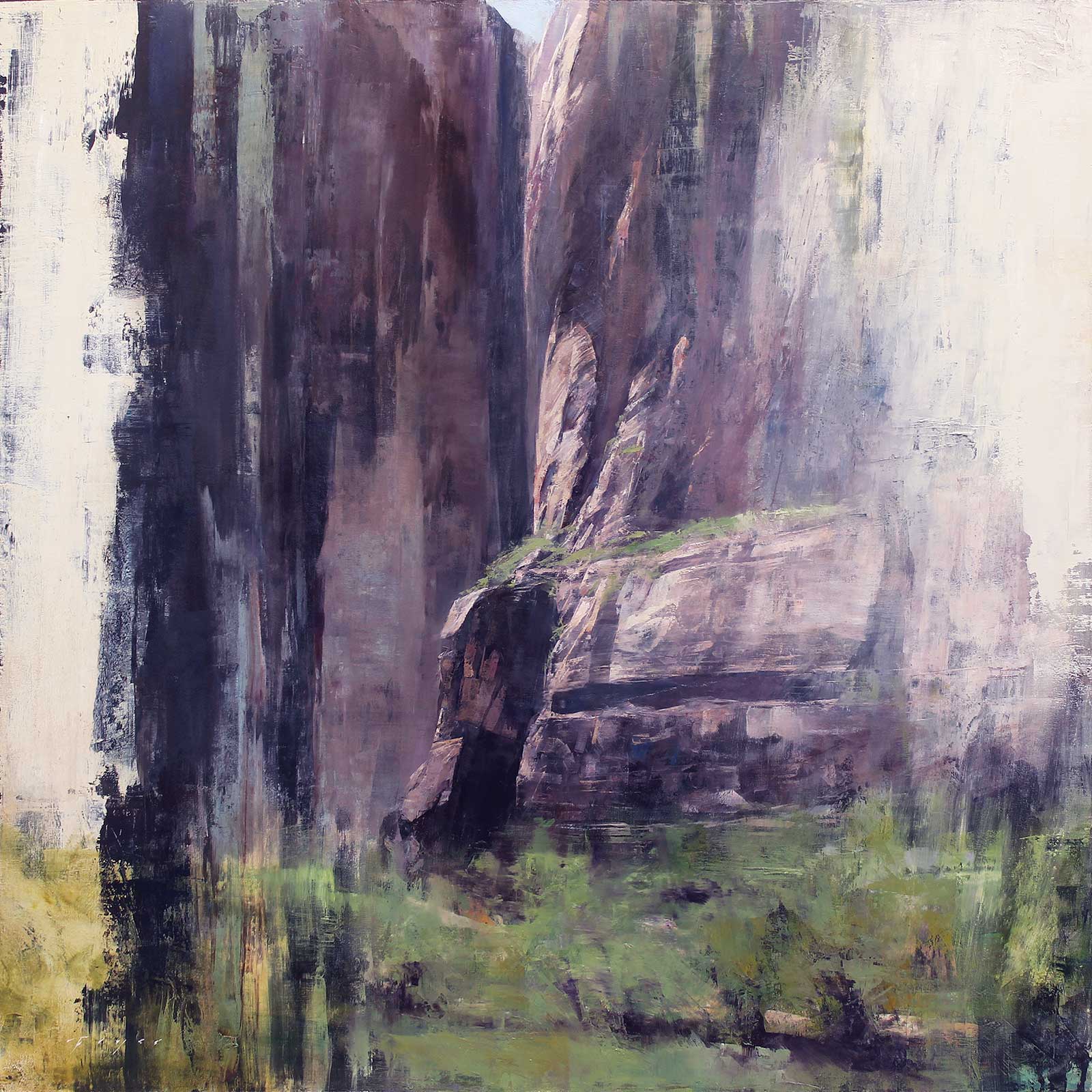
Douglas Fryer, Desert Canyon, oil on panel, 48 x 48" (121 x 121 cm)
SAS: Why did you choose to teach there?
DG: The school is a facility dedicated to the creation of new and beautiful works of art. The perfect place to teach, in a lovely setting, and so close to galleries and museums, restaurants and shops. I always look forward to the workshops, the students and assisting them and their own progress as visual artists.
SAS: What courses are you teaching this season?
DG: “Suggesting Reality and Composition: Structure, Unity and Variety” from January 9 to 13, 2023. I challenge students to think about the words “suggesting reality.” If we suggest reality, then we look at various methods, techniques and conventions used to mimic reality on our painting surface. Light logic, perspective, measurement, internal structure, ratios, color matching, etc., are all conventions we use to make representational works. But if we suggest reality, we look at methods to restrain some of those conventions, and incorporate others such as abstraction, softening, blurring, exaggeration, and obscuring, for emotional or conceptual purposes. We discuss painting from memory or invention, as well as how our eyes truly see, as opposed to how we often assume we perceive things.
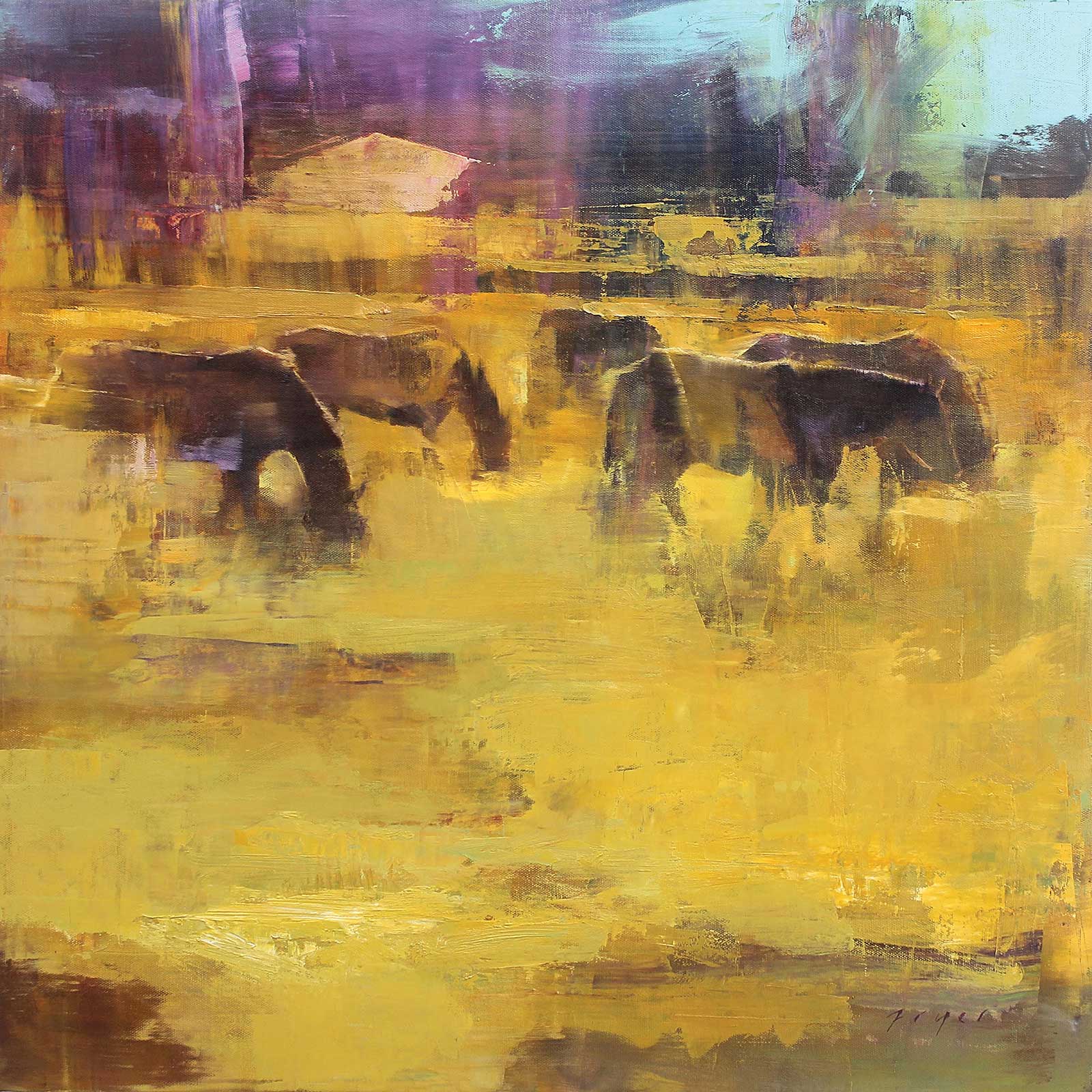
Douglas Fryer, July, oil on panel, 24 x 24" (60 x 60 cm)
There’s also “The Power of Ambiguity” from April 24 to 28, 2023. This workshop is all about choices. We dare to look at the information an artist edits out or obscures, what they choose to leave incomplete, or ideas they imply without a clear, straightforward resolution. This is frequently what is of most value in a work of art…An artist makes choices regarding the interpretation and presentation of the subject: its emotion, concept, and forms. I work with students to reinforce an understanding of composition, tone theory and form. To explore methods to break up and strip down the subject, then reconstruct it in new and surprising ways, while also contemplating the important power of content, symbol and abstraction.
SAS: What is your favorite subject to paint?
DG: I live in Utah, and I love painting the landscape around where I live. Something will spark an idea for a painting, and I begin with the forms, the patterns of light and dark, the shapes that play off each other, warms and cools, all of which is the basis of abstract composition.
I may be drawn to paint something because of a significant memory, or as a representation of a repeating theme in my life or sometimes I select subjects because of the artistic energy they offer as a foundation for the construction of the work of art. Once I decide on a subject, everything that follows is abstraction and the play of the materials and tools.
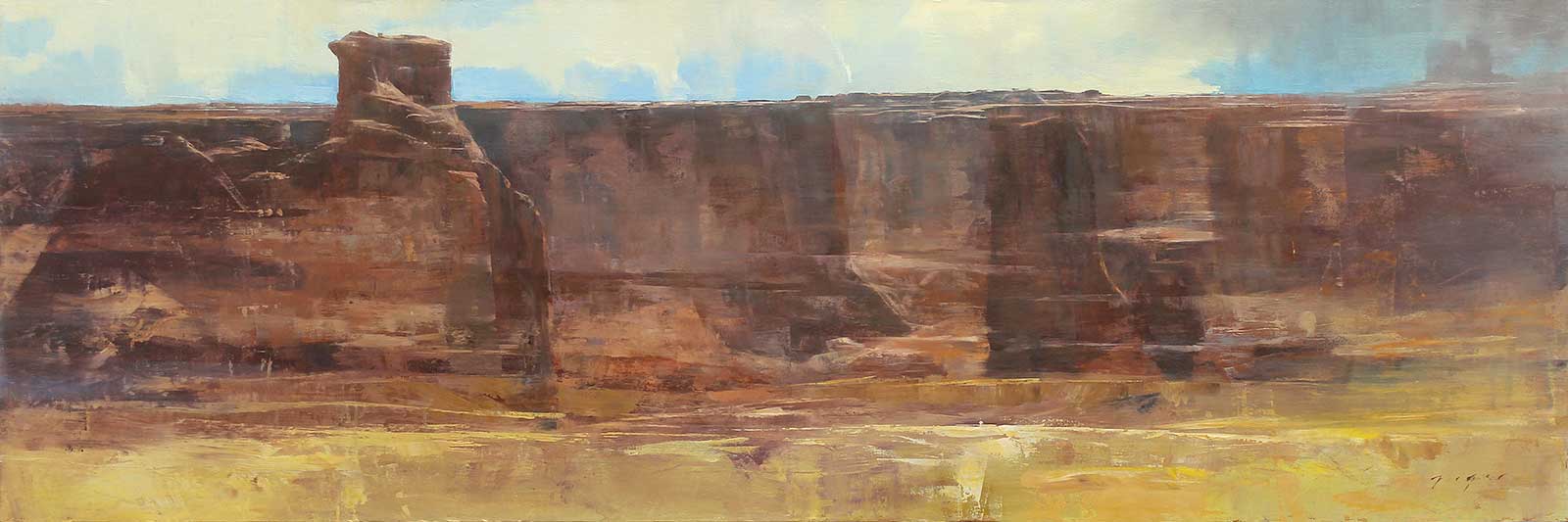
Douglas Fryer, Canyon Wind, oil on panel, 20 x 60" (50 x 152 cm)
SAS: What inspires you?
DG: I tend to contemplate things at great length, and then in a burst of energy I’ll get to work. I’ve always tended to be a quiet observer, but when I have something to say I try my best to do it in a meaningful, beautiful way. I’m most happy creating work that is comforting and healing and inspires contemplation and insight in the viewer’s mind and heart. Art is an emotional and aesthetic experience and has a great potential to influence the human spirit.
SAS: What do you want to people to see and feel in your art?
DG: I am introspective and reflective when I paint. I strive for a sense of peace and unity, with a recognition of the mysterious complexity there is in nature. A painting is the evidence of the artist’s frame of mind, his craft, his values and his imagination. Hopefully the viewer shares in this and senses the harmony I feel when creating it. —
Visit www.scottsdaleartschool.org for more information on the school and its upcoming workshops.